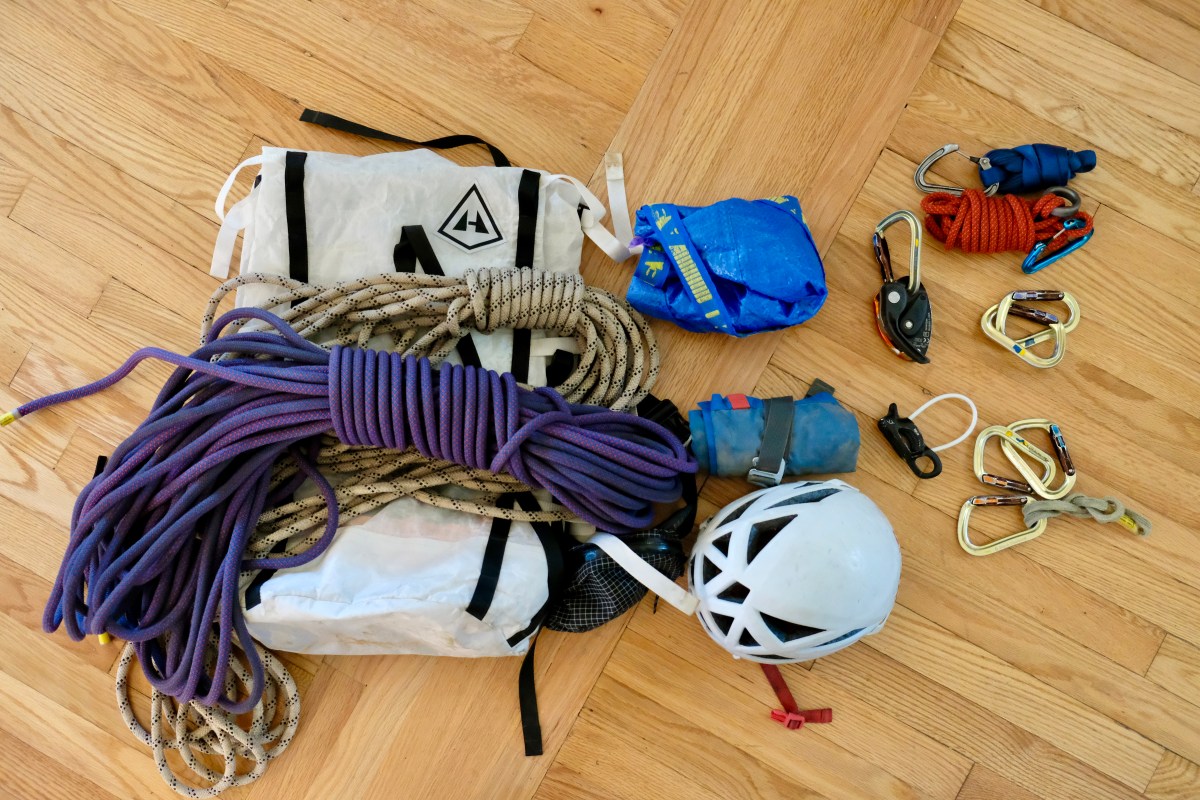
When I started climbing outdoors, I’d just finished Earth Treks’ Top Rope Systems I course. I was excited and wanted to start climbing outdoors right away. I didn’t know what to buy, so I just put together what I thought made sense.
Now I know. This is stuff I wish I’d known when I started out.
This list is mostly specific to Carderock, Maryland and Great Falls, Virginia, where locals expect you to set your top-rope anchors specifically using burly static line tied in bowline hitches around trees and large boulders. (You’ll get heckled if you do it any other way).
1. Rope
REI has a nice article about the different kinds of climbing rope.
I started with an all-around single climbing rope. These ropes are good for any kind of climbing, but they stretch a lot – sometimes too much for top-roping.
I really like semi-static ropes for top-roping. They stretch just enough to soften a top-rope fall. They’re usually marketed as gym ropes for top-roping.
If I wanted one rope that does everything, I’d get an all-around climbing rope. But I top-rope often enough that I also bought a burly, semi-static rope. I have the Sterling ReVo in 40 meters, which is a great length for Carderock and Great Falls.
See current reviews on climbing ropes.
2. A Static Rope for Tying Anchors
Any burly (10+ mm) static rope will do. I use 120 feet (40 meters) of static rope for Carderock/Great Falls.
REI sells static rope by the foot.
Don’t buy rope at the hardware store! It is not designed for mountaineering and is much weaker than UIAA-rated static rope.
3. Three or Four More Locking Carabiners
I needed 2 carabiners for my climbing rope to slide through my top-rope anchor, and another carabiner to secure myself with a prussik while setting the top anchors. I loved the Black Diamond Magnetron Vaporlocks, but they are now out of production.
See current reviews on locking carabiners.
4. An Autoblock Cord
Falling from the top while setting anchors is a common cause of death while top-roping. This issue is personal for me. A friend of mine, Reid Judson Hunt, died looking over the lip before an ice climb. While finishing up your top-rope anchor, make sure you’re tied into the anchor with your GriGri or an autoblock cord.
Any 6-7 mm cordelette tied into a loop will work, but I really love the pre-sewn Sterling hollow block loops. They just work better and are smoother to use than cordelette.
5. A Belay Device with Assisted Braking
It’s a little harder to stop falls outdoors than it is in the gym. You’ll be using a skinnier and probably a dry-coated rope that will want to slide through your ATC. Also, at Movement and other gyms, the rope usually wraps around the pulley at the top anchor twice, creating extra drag. You won’t have that outdoors.
You will want a belay device with teeth or assisted braking. The Petzl GriGri is the current gold standard for assisted braking devices. In a top-rope situation, it’s almost foolproof. It automatically locks when the climber falls.
6. A Big Backpack To Carry Everything
You will be carrying all of this, plus your shoes, your harness, at least a liter of water, and your lunch. Most people prefer to carry ropes inside of their bag rather than on top of it, if they can (but if their bag gets full, they secure the ropes on top). This is a lot of gear, and a 15 or 20 liter backpack is not going to work. You will want a 30-40 liter crag pack.
A crag pack is different from a regular hiking backpack in that it is designed to be worn while climbing. Most crags involve some scrambling to access them. Crag packs are narrower than hiking backpacks and usually open only at the top. They usually have a strap on top for securing the rope.
7. Other things
I assume that you already own shoes, a harness, and a carabiner for belaying. See my post on buying gear for climbing indoors.
You probably want a helmet. People don’t use helmets at Great Falls and Carderock because there’s not much loose rock that could fall on climbers below, but if you move out to other crags, a helmet is a must.
I think you’d really like approach shoes, if you are willing to spend the money. These are sneakers or hiking boots with rock climbing rubber soles, so they make it easy to scramble around the crag without worrying so much about slipping. People say you can climb 5.9 in them. I’m not that awesome but you can definitely climb 5.easy.
You might want a rope tarp to keep your rope a little cleaner. Another good option is just one of those IKEA blue bags, which can be bought from Amazon. I think this is cheaper and more useful than a dedicated rope bag.
8. What Not to Buy
Slings, runners, and tubular webbing come in handy for other things, but you generally don’t need them for Carderock or Great Falls. Tubular webbing is not as strong or abrasion-resistant as static rope.
Trad protection devices like cams/SCLDs are occasionally helpful for setting up a redirect. The Aid Box area at Great Falls is also most easily set up using cams/SCLDs.
You don’t need a rope bag, as I mentioned. A tarp, or a blue IKEA bag, is cheaper and packs down smaller.
Summary: Gear Checklist
- Harness
- At least three locking carabiners
- Belay device
Recommended: Petzl GriGri - Climbing Shoes. Flat-soled shoes are the most comfortable.
Recommended: La Sportiva Mythos, La Sportiva Tartantulance, or Scarpa Helix. - 40 meter climbing rope. See above.
- 40 meters (120 feet) of burly (10+ mm) static rope.
- Large crag backpack (30-45 liters).
- Water bottle.
- Climbing helmet. (optional at Carderock and Great Falls).
- Approach Shoes (optional).
- Rope tarp or blue IKEA bag (optional)
 Derek Braun